The Geology of Quartz Veins: How They Form in Cracked Rock
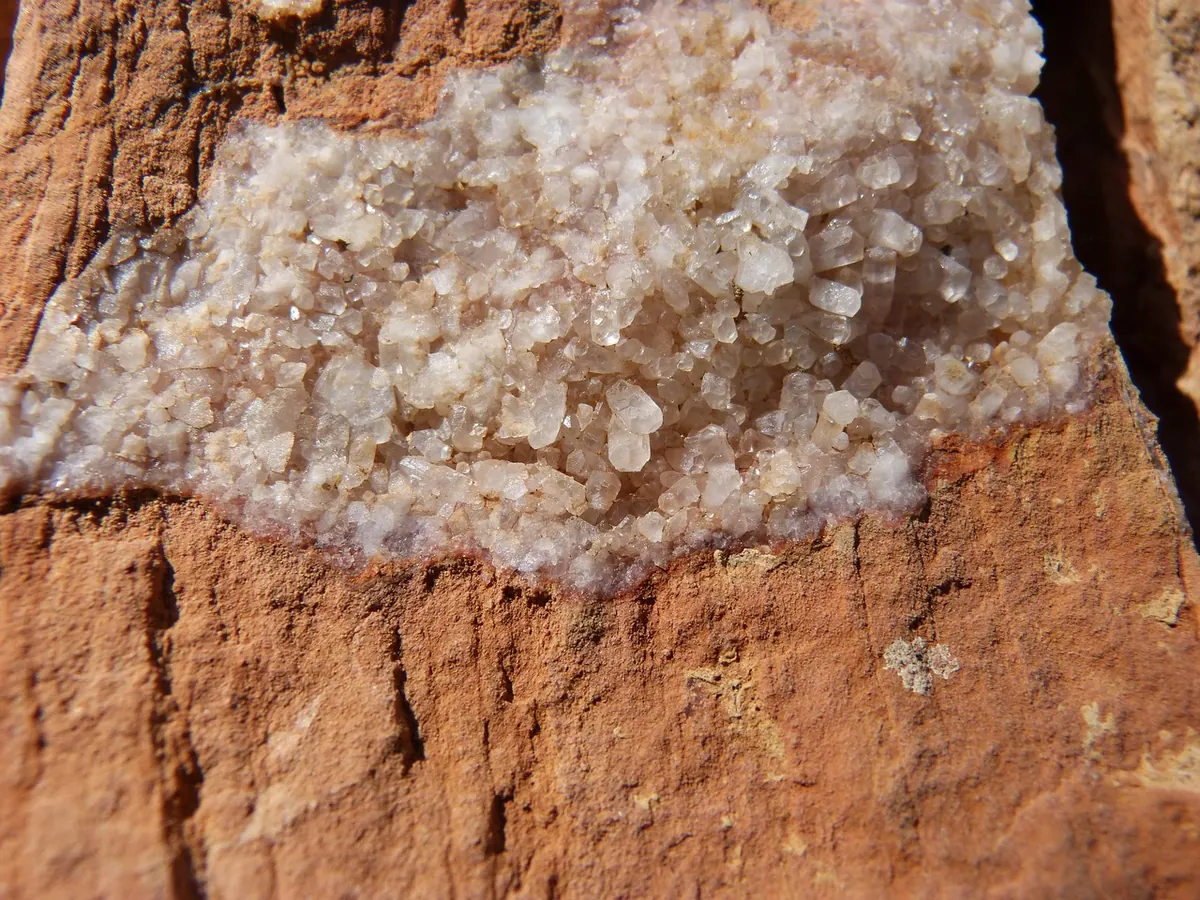
Walk almost any rocky coast — north Cornwall, the west Highlands, the flanks of Dartmoor — and you will meet them. White ribbons slicing through dark slate. Fat milky pods shouldering out of granite. Quartz veins look simple: a mineral, a crack, a story that seems to end there. In fact they are among the most informative structures you can find in the field, because each one records where hot fluid travelled, how quickly it cooled, and how many times the rock split open. Learn to read them and a plain lump of white stone turns into a set of directions.
Silica has to dissolve before it can be deposited
Quartz is stubborn at the surface. In cool, neutral water at everyday temperatures only a few parts per million of silica will dissolve, which is why beach sand lasts as long as it does. Heat the water, raise the pressure and shift the chemistry, and the situation reverses. Between roughly 150°C and 400°C, silica goes into solution as silicic acid, and hot alkaline fluids can carry far more of it than cold ones.
The same rules work in reverse. Anything that cools the fluid, drops its pressure, makes it boil or mixes it with a different water pushes silica back out of solution. A vein is the receipt for that change.
Where the hot fluids come from
Hydrothermal fluid is not all the same, and its origin leaves a fingerprint on the vein it builds. Three broad sources matter.
- Magmatic fluids. As a granite body crystallises, water and other volatiles that do not fit into mineral structures are expelled. Those fluids are hot, often acidic, and carry dissolved silica and metals.
- Metamorphic fluids. Bury and heat a pile of mudstone and its hydrous minerals — micas, clays, chlorite — break down and release water. That water migrates along pressure gradients, scavenging silica as it goes.
- Meteoric and basinal water. Rainwater, or deep formation water, can circulate kilometres down through fractures, warm up, leach silica from the host rock and rise again. Plenty of quartz veins formed with no magma involved at all.
Whatever the source, one condition is non-negotiable: the fluid needs somewhere to go.
Fractures: the plumbing that makes veins possible
A vein is a fossil fracture. Before it filled, it was open space, and even a hairline crack offers vastly more permeability than solid rock. Cracks open for several reasons. Tectonic stress during faulting or folding is the big one. Contraction as an intrusion cools is another. Then there is hydraulic fracturing, where fluid pressure itself exceeds the least principal stress and prises the rock apart — the rock does not need to be pulled open, it can be pushed.
Why some cracks stay empty
An open fracture is necessary but not sufficient. The fluid passing through has to be silica-saturated, and it has to be able to precipitate. A fracture that stays connected to surface water, or one that never sees a hot fluid at all, simply remains a crack. That is why veins cluster in particular districts and particular host rocks rather than appearing evenly everywhere.
How a vein actually grows: crack, seal, repeat
Most veins are not a single event. The crack opens by a fraction of a millimetre, fluid rushes in, pressure drops, and quartz precipitates on the walls, sealing the gap. Stress rebuilds, the rock splits again along or near the same plane, and the process repeats. Do that a few hundred times and you get the textures you see in the field.
- Comb or prismatic texture. Crystals point into the void, roughly perpendicular to the walls. One of the clearest signs that open space existed.
- Fibrous quartz. Long, thin crystals running across the vein, typical of repeated small openings.
- Banded or crustiform layers. Successive shells of deposition, common in shallow systems where boiling is happening.
- Massive milky quartz. Countless tiny nucleation sites and no room for good crystals. The milky colour comes from microscopic fluid inclusions scattering light.
- Vuggy quartz. Cavities lined with terminated crystals — where open space survived to the end.
Those fluid inclusions are more than a curiosity. Trapped during growth, they preserve samples of the fluid itself, and their arrangement along growth zones lets a vein be read a little like tree rings.
Pegmatites: quartz from the last of the melt
Pegmatites are a different route to much the same result, and they are frequently mistaken for veins. They form from the final, water-rich dregs of a granitic melt. By that stage the material is low in viscosity, rich in volatiles and slow to cool, so crystals have both time and space to grow large. Quartz appears as the core of zoned bodies, as intergrowth with feldspar in graphic granite, or as crystals lining miarolitic cavities inside the pegmatite itself.
That cavity-filling quartz is where many fine specimens come from. It is not hydrothermal veining in the strict sense — the material came from a melt, not an aqueous fluid — but the two occur side by side in the same terrains, and telling them apart is part of the interest.
Reading a vein in the field
Next time you find one, work through this.
- Look at the contacts. Sharp, planar walls mean an open fracture. Irregular, gradational edges suggest the quartz replaced the rock rather than filling a gap.
- Measure the orientation with a compass clinometer, and note whether there are several sets. Cross-cutting relationships tell you which set came first.
- Describe the internal texture — comb, fibrous, banded, massive, vuggy.
- Hunt for offset markers: a vein cutting an older vein, or a dyke displaced across the fracture. That is direct evidence of movement.
- Note colour and any staining. Iron oxides along fractures are usually later weathering, not part of the original vein.
Before you set out
Quartz veins are common, but good exposures are often in awkward places. Check access before you go. Most land in the UK is privately owned, and collecting on
Photo: makamuki0 / Pixabay